
 01
01The world becomes a doorway
A MacBook.
An AI.
An inheritance.
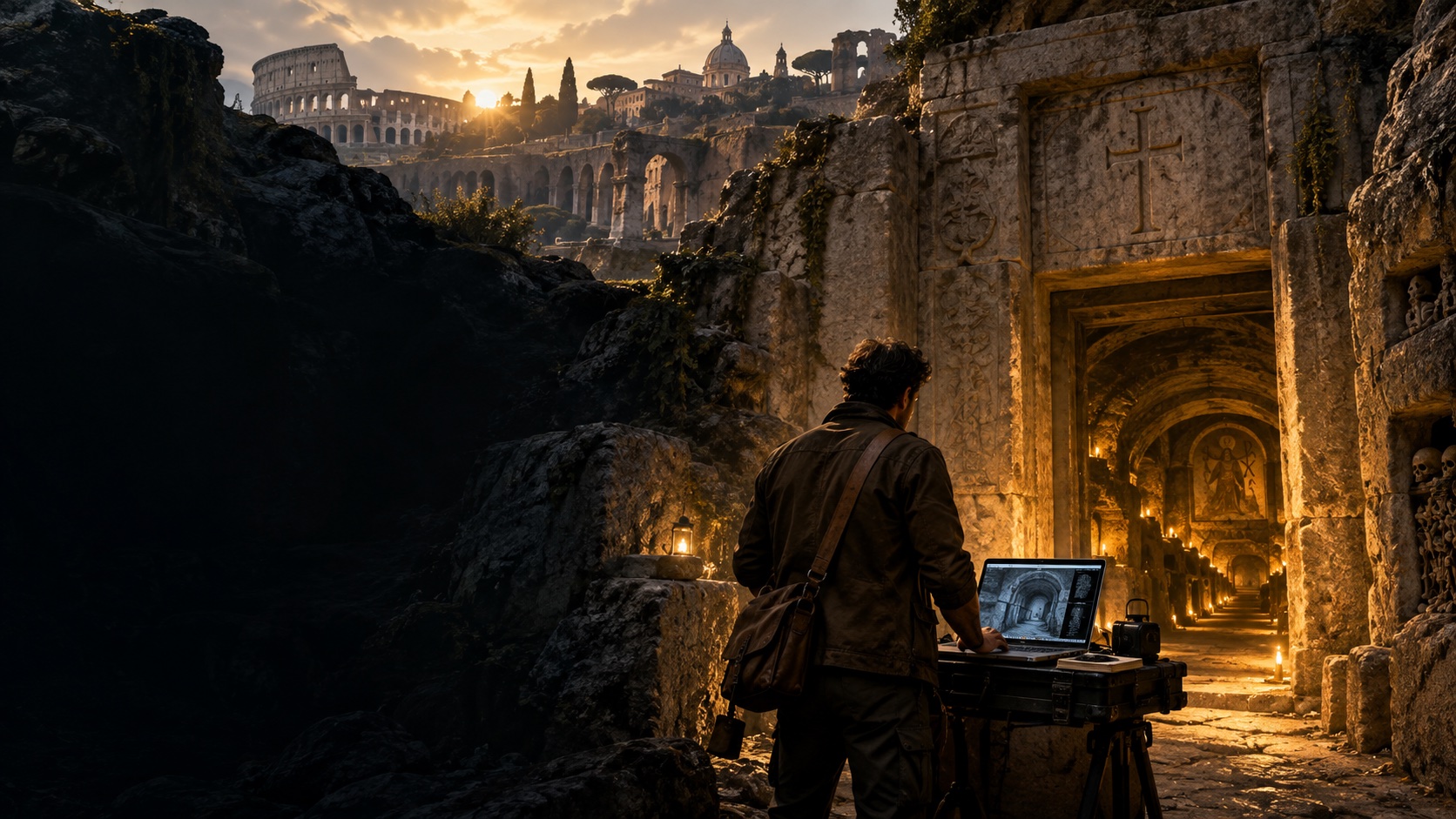
Christian Cassarly is exploring the world digitally with his MacBook and AI technology, creating a place for you to explore the Christian artifacts of history. His expedition travels through photographs, collections, archaeological records, and the surviving marks of lives lived centuries before ours.
The screen becomes a threshold. Beyond it are tombs, catacombs, ancient cities, monastery walls, and museum rooms. A small object can open an enormous story: a community, a language, a moment of worship, a memory that has outlasted the people who first held it.
The mission is to gather that scattered material inheritance into the Codex, where the curious reader can begin with wonder and continue into understanding. The distance between a historical object and a living person becomes smaller when its story can finally be read.
 02
02Beneath the silence
Some voices
waited in stone.
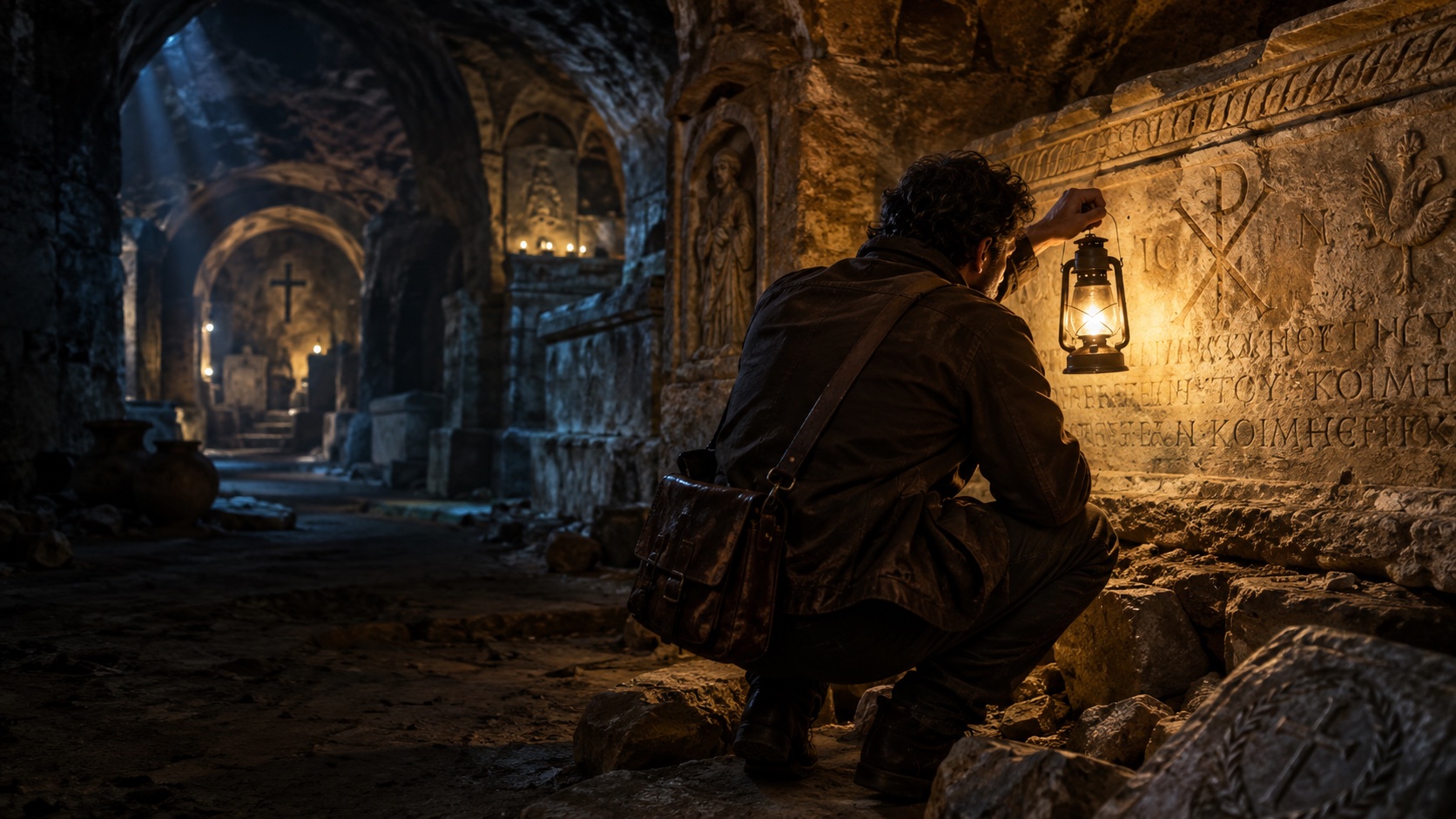
Imagine entering a chamber whose walls have held their silence for generations. Light catches the edge of a carved letter. A name emerges. A prayer takes shape. What looked like a weathered surface begins to reveal the human intention behind it.
Artifacts carry more than age. They carry choices: what a people wanted remembered, what they believed deserved beauty, what they placed beside their dead, and what they made for daily use. Sometimes the surviving words are clear. Sometimes a broken edge has taken part of the sentence with it.
Christian’s digital journey begins with attention to those details. The artifact is encountered as an object before it becomes an interpretation. Its material, place, people, and condition help explain the writing it bears—and the world in which that writing mattered.
 03
03The inscription becomes readable
Patient attention.
New instruments.
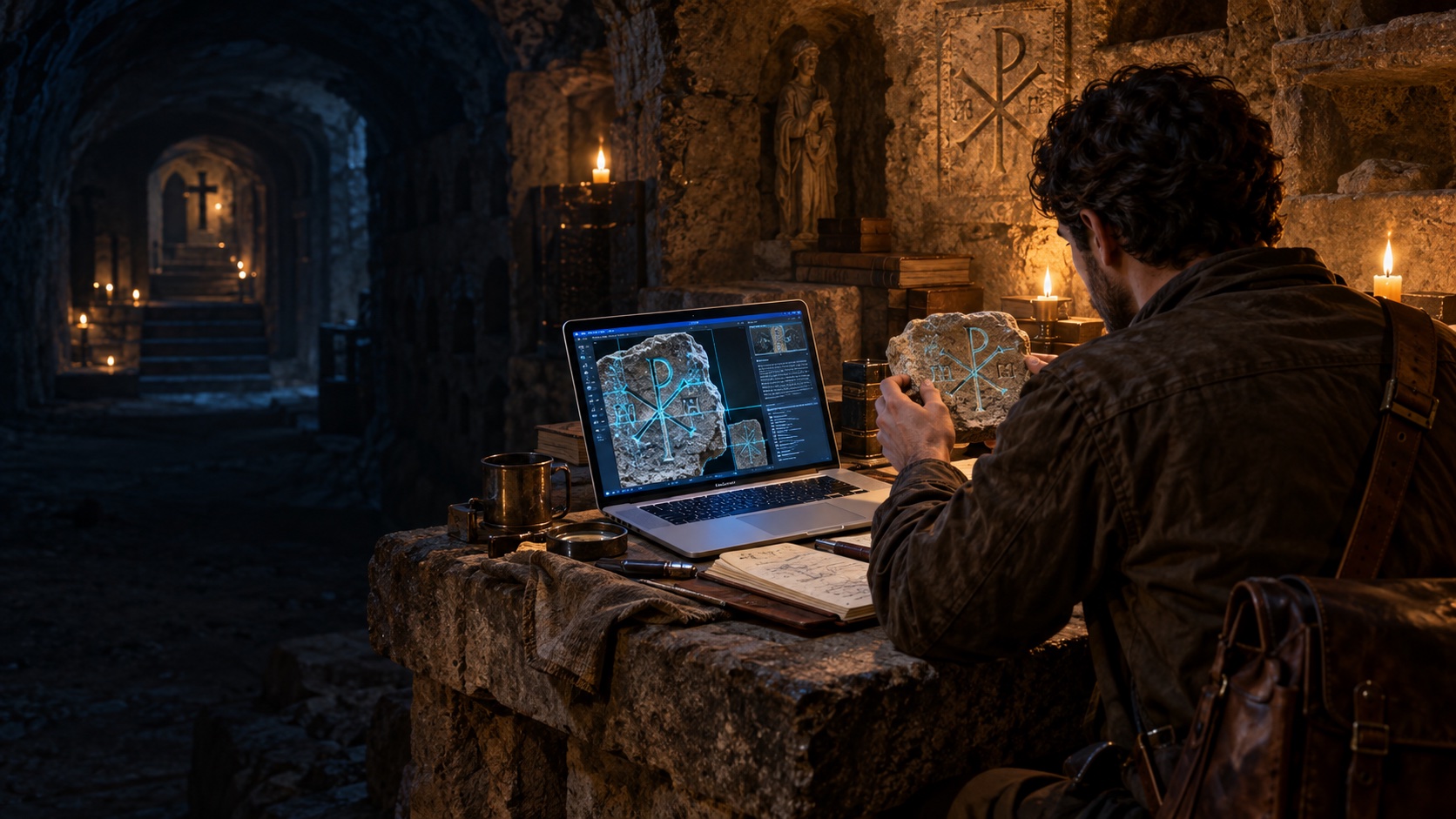
With AI-assisted inspection and research, Christian is developing a process for restoring transcriptions and examining readings that have remained difficult, incomplete, or poorly understood. Some artifacts already have scholarly transcriptions; others invite a closer comparison of the surviving characters and the interpretations built around them.
A photograph is studied. Letters are compared. Abbreviations are explained. Existing readings are checked, and possible alternatives are considered. The work reaches beyond a string of characters toward the meaning of a sentence, the language of a community, and the significance of an object.
A biblical passage may survive through many manuscripts and fragments. Each witness has its own journey. Where applicable, the reader will be able to explore corresponding Scripture and Vulgate passages while retaining the artifact’s original words.
Restoration does not make every lost word recoverable. Where the evidence breaks, the reader will be able to see the break. The ambition is a clearer encounter with what survives: transcription, translation, and explanation working together to make a difficult inheritance more accessible.
 04
04Gathering the fragments
A bag filled
with memory.
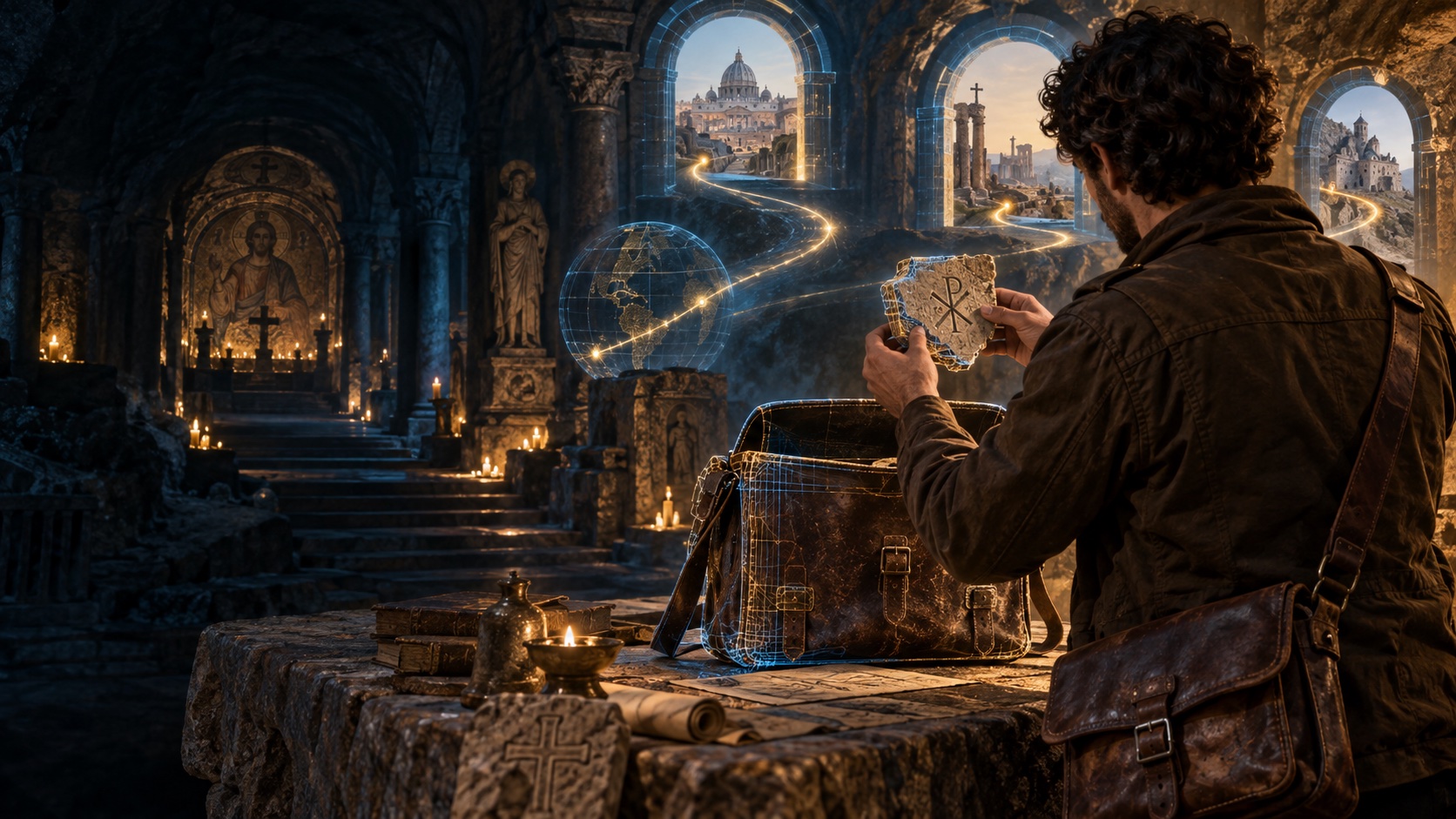
In this cinematic journey, Christian reaches for an artifact, turns it in his hands, and gathers it into his bag. The gesture gives the digital mission a physical language: a fragment rescued from obscurity, a story carried forward, a piece of history given a place among the works of the Codex.
What is gathered is its digital presence: images, inscriptions, translations, and the history needed to understand them. The collection is being designed as an arena of discovery, a portal of works in which objects become readable encounters rather than isolated pictures.
Each entry will introduce the artifact, tell its journey, and open its meaning. The person who knows nothing about an inscription should be able to arrive with a question and leave with a richer understanding of the lives, beliefs, and places surrounding it.
Cinematic metaphorThe explorer’s bag represents gathering digital records and reconstructions into the Codex.
05Wisdom beyond the surface
The object opens.
Understanding deepens.
These artifacts can unlock Christian wisdom by opening the historical world around our faith. Some preserve biblical words themselves: papyrus fragments and other textual witnesses let us encounter the material history of Scripture. Others reveal how Christian communities expressed hope, practiced worship, and carried belief through ordinary life.
Through sacred art, inscriptions, and objects made for prayer, the believer can explore how Christianity developed across places and centuries. Beauty becomes a language of devotion. A symbol can disclose a community’s hopes; a surviving prayer can bring its faith close to our own.
The purpose is to expand the mind of the believer: to seek the purity and wisdom of Christianity, understand its historical expressions, and consider the place these objects hold in the Christian walk. The Codex joins historical explanation with clearly identified Scripture-grounded reflection, giving each encounter room to deepen understanding.
The mystery becomes an invitation to look more carefully. Understanding grows when we can see both what an artifact reveals and what remains unanswered.
 06
06The spatial inheritance
History becomes
a place to enter.
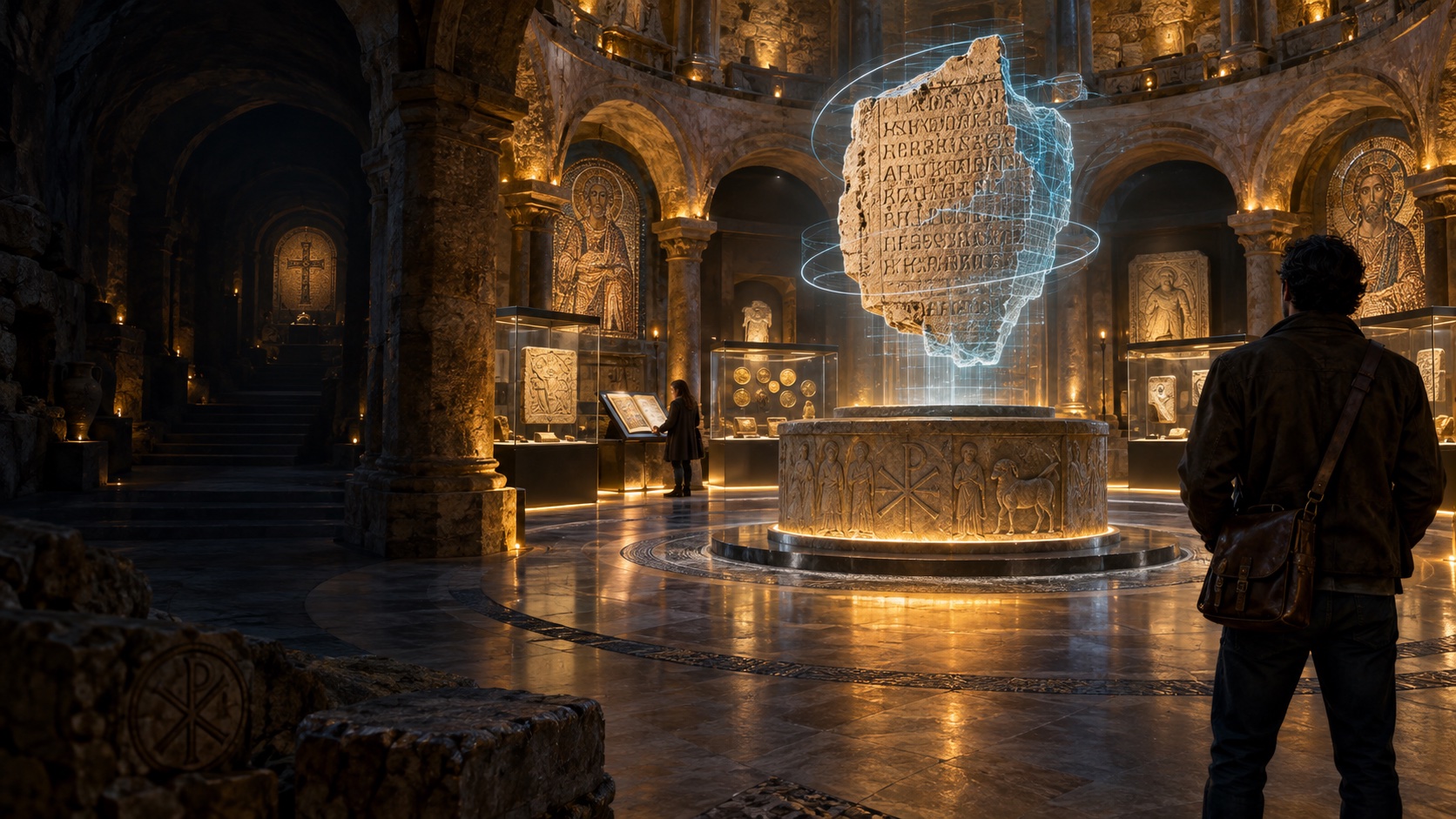
Christian’s vision is to re-digitalize these artifacts for a spatial environment. An object can stand at the center of a room, turn through a full circle, and open its inscription when the reader selects it. The translation becomes a doorway into the object's wider story.
The planned collection joins images with literature: substantial reader editions explaining significance, people, place, and Christian connections. A catalog will offer direct discovery, while a future map will lead from continents to countries, regions, and the artifacts associated with them.
Farther ahead lies Codex Explore: an environment in which the journey itself becomes spatial. Readers may enter interpreted catacombs and historical settings, encounter objects within their context, and move between the artifact and the work that explains it.
This cinematic opens that horizon. The first task is already clear: build the records faithfully, make their words understandable, and create an experience worthy of the history they carry.